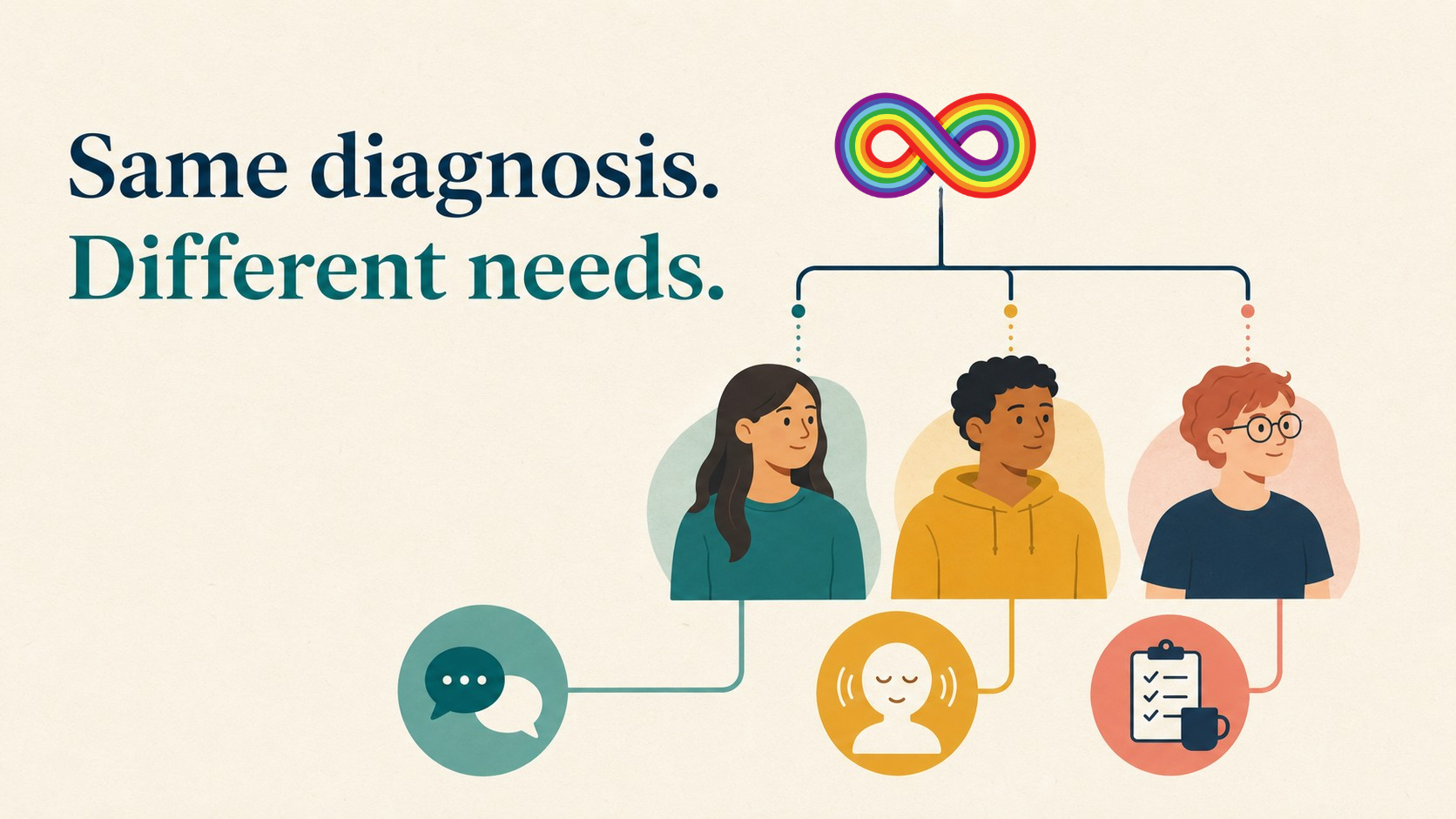
Two people can have the same diagnosis and experience life in completely different ways.
They may communicate differently, respond to different environments, enjoy different activities, have different strengths and need very different kinds of support. Even when two people use a similar behaviour, the reason behind it may not be the same.
A diagnosis can provide useful information, but it does not provide a complete instruction manual for supporting a person. Effective support begins by understanding the individual: their communication, health, sensory experience, relationships, culture, history, preferences, goals, environment and current capacity.
This is the heart of individualised support. Rather than asking only, “What support is usually used for this diagnosis?”, we also ask, “Who is this person, what is happening for them, and what would help them participate in life in a way that is meaningful to them?”
What Is Individualised Support?
Individualised support is support designed around a particular person rather than a diagnostic label, age group or standard program. It takes account of what matters to the person, what they can already do, where they experience difficulty and the circumstances in which support will be used.
It does not mean that every session must be completely different or that evidence-based approaches should be abandoned. It means that clinical knowledge and evidence are applied thoughtfully, collaboratively and responsively to the person in front of us.
Individualised support may involve adapting:
- the way information is communicated
- the pace and length of a session
- the environment in which support occurs
- the level of structure or predictability provided
- the goals being worked towards
- the skills being taught
- the people involved in planning and implementation
- the way progress is recognised and measured
For one person, useful support may involve quiet conversation and reflection. Another person may engage more readily through games, movement, demonstrations, pictures or a visual schedule. Someone else may need shorter interactions, more processing time, an augmentative and alternative communication (AAC) system or support within familiar daily routines.
The method should serve the person. The person should not be expected to fit the method.
What Can a Diagnosis Tell Us?
A diagnosis can be valuable. It may help a person and the people around them understand a pattern of experiences, identify possible supports, access services and find language for something that previously felt confusing.
Depending on the assessment and diagnosis, it may offer information about areas such as communication, attention, learning, sensory processing, emotional regulation, movement or daily functioning. It may also help clinicians know which questions to explore in greater depth.
But a diagnosis describes a recognised collection of characteristics. It does not tell us exactly:
- how those characteristics are experienced by this person
- which strengths and skills the person already has
- what they value or want for their life
- which environments support or overwhelm them
- how they prefer to communicate
- what a particular behaviour means in a particular situation
- which strategy will be safe, respectful and effective
FABIC’s approach to assessment reflects this distinction. A diagnosis may contribute to understanding, but the purpose of assessment is not simply to apply a label. It is to understand the smallest factors that may be influencing behaviour and lay the foundation for an individualised plan.
You can learn more about FABIC’s behavioural and developmental assessments.
Why Can People With the Same Diagnosis Have Different Needs?
No diagnosis exists separately from the person’s wider life. Each person brings a unique combination of body, experiences, relationships, abilities, challenges and circumstances.
Differences may include:
- Communication: One person may communicate fluently through speech, another through an AAC device, signs, pictures, gestures or behaviour. A speaking person may also find words difficult to access when overwhelmed.
- Sensory experience: Sound, light, movement, touch, smell, temperature and internal body sensations can affect people differently.
- Health and co-occurring conditions: Pain, sleep, epilepsy, anxiety, intellectual disability, ADHD, gastrointestinal concerns, medication effects and other factors can change support needs.
- Skills and current capacity: A person’s ability to wait, communicate, cope with change or complete a task may differ across environments and from one day to another.
- Life history: Learning experiences, trauma, relationships, culture, loss and previous support can influence how a person experiences the present.
- Preferences and interests: What feels motivating, enjoyable, comforting or meaningful is personal.
- Environment: A person may function very differently at home, school, work or in the community because the expectations, people and sensory conditions are different.
- Goals: One person may want to live more independently. Another may prioritise communication, relationships, employment, emotional wellbeing or participation in a favourite activity.
This diversity is particularly well recognised in autism. The term “spectrum” does not mean that people sit neatly on a line from less autistic to more autistic. Autistic people can have very different combinations of strengths, support needs, communication styles and co-occurring experiences.
The same principle applies across diagnoses. A label may point us towards useful areas to explore, but it cannot replace getting to know the person.
The Same Diagnosis Can Look Very Different
Consider two fictional people who both have an autism diagnosis.
| Person A | Person B |
|---|---|
| Communicates mostly through speech but finds it difficult to recognise and explain rising anxiety. | Uses an AAC device, gesture and movement, and understands more spoken language than unfamiliar people may assume. |
| Enjoys busy social activities but becomes distressed when plans change without warning. | Prefers quieter environments and may leave when sound or social demands become overwhelming. |
| Wants support to recognise body signals, prepare for changes and repair relationships after conflict. | Needs communication partners who allow processing time, honour AAC and make quieter spaces reliably available. |
A generic “autism strategy” would be unlikely to meet both people’s needs. Even a strategy that benefits one person could create additional difficulty for the other. For example, adding more verbal explanation might reassure Person A in a settled moment but overwhelm Person B when their processing capacity is reduced.
Good support does not ask which person is presenting autism “correctly”. It asks what each person is communicating and what will increase their access, participation, safety and quality of life.
The Same Behaviour Does Not Always Mean the Same Thing
Individualisation becomes even more important when support is being provided for behaviours of concern.
Imagine three people all leave a room when asked to begin an activity:
- One is experiencing physical pain and movement makes it worse.
- One does not understand the instructions and wants to escape possible embarrassment.
- One finds the room unbearably noisy and is moving somewhere quieter.
The visible behaviour is similar. The support should not be.
The first person may require medical investigation and physical adjustments. The second may need accessible instructions, reassurance and a reliable way to ask for help. The third may benefit from sensory and environmental changes.
If all three people are given the same reward for remaining in the room, the underlying issue may remain untouched. At worst, the strategy could ask a person to tolerate pain, confusion or sensory distress without a safe way to communicate it.
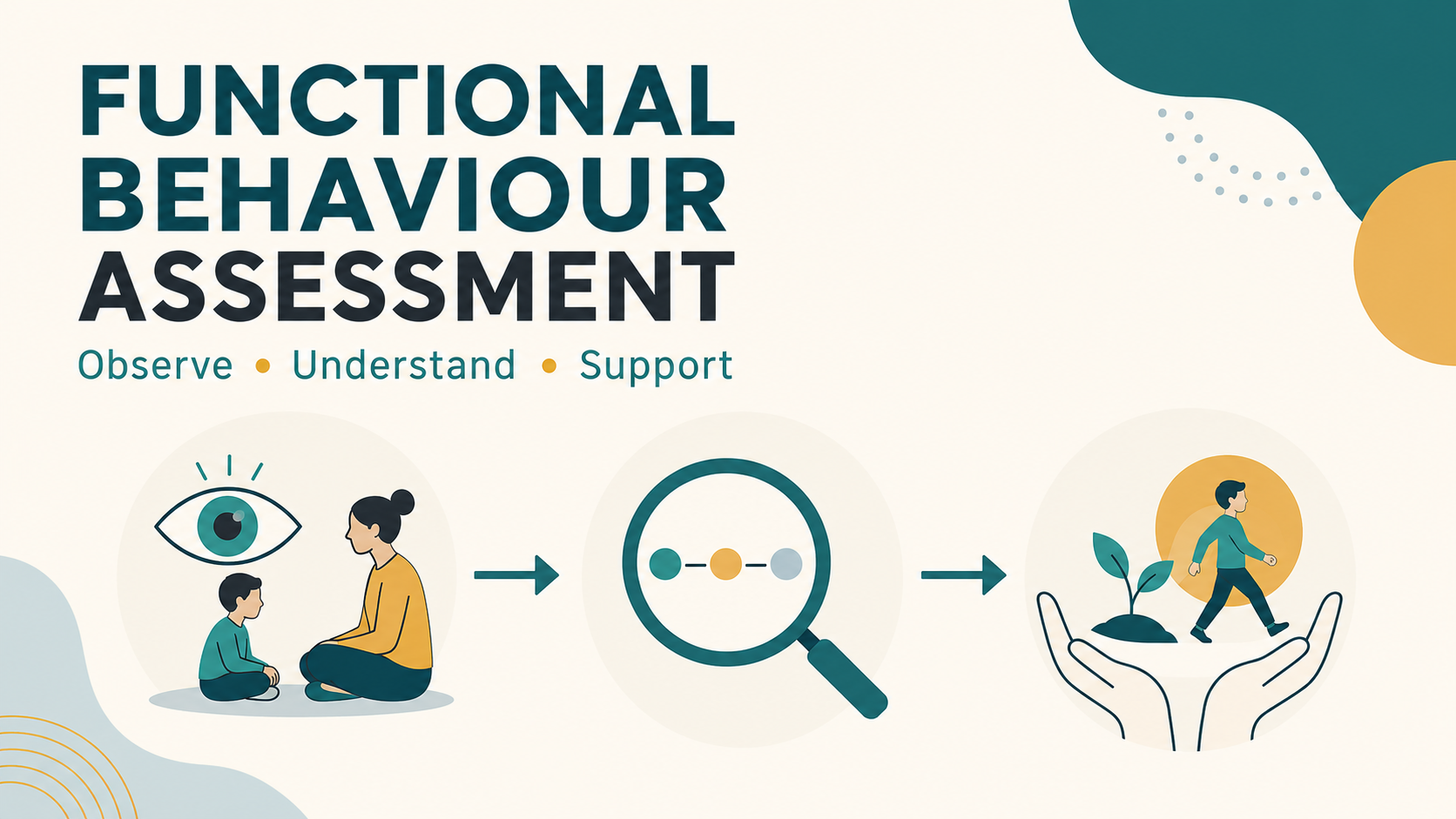
This is why understanding the function of behaviour matters. The function is the purpose a behaviour serves or the outcome it helps a person access or avoid. It is a working explanation developed through assessment, observation and collaboration—not an assumption based on diagnosis.
Learn more about how FABIC investigates the reasons behind behaviour through functional behaviour assessment.
Diagnosis Is Not Identity
FABIC clinicians repeatedly emphasise that a person is not their behaviour. The same care is needed with diagnosis: a person has a diagnosis, but the diagnosis is not the whole person.
When support teams begin to see only a label, they may unintentionally:
- lower expectations without exploring the person’s actual abilities
- interpret every behaviour as part of the diagnosis
- overlook pain, grief, anxiety, trauma or environmental barriers
- speak about the person instead of communicating with them
- prioritise making someone appear “typical” over supporting meaningful participation
- miss strengths, preferences and goals that do not fit a stereotype
A diagnosis should increase understanding, not narrow our view of the person.
Individualised support keeps the whole human being visible. It recognises that the person is an active participant in their own life, not simply a collection of symptoms to manage.
What Does Person-Centred Support Look Like in Practice?
Person-centred support places the individual at the centre of decisions about their life and services. Current NDIS Commission guidance describes person-centred practice as focusing on the person’s needs and circumstances, including their involvement in service planning and delivery.
In everyday practice, this may look like:
- communicating directly with the person in a way they are most likely to understand
- providing genuine choices rather than decisions that have already been made
- including family, carers and trusted supporters with the person’s consent and direction
- learning how the person expresses yes, no, discomfort, interest and the need for a break
- recognising strengths and building on existing skills
- setting goals that are meaningful in the person’s real life
- making reasonable adjustments to environments, demands and communication
- checking whether a strategy is working and changing it when it is not
- respecting culture, identity, values, relationships and the dignity of risk
Person-centred does not mean the person is left to manage every decision without support. Some people need information presented differently, more time, supported decision-making or help from people who know their communication well. The goal is to increase their involvement and control, not replace their voice.
How FABIC’s Body Life Skills Program Supports Individualisation
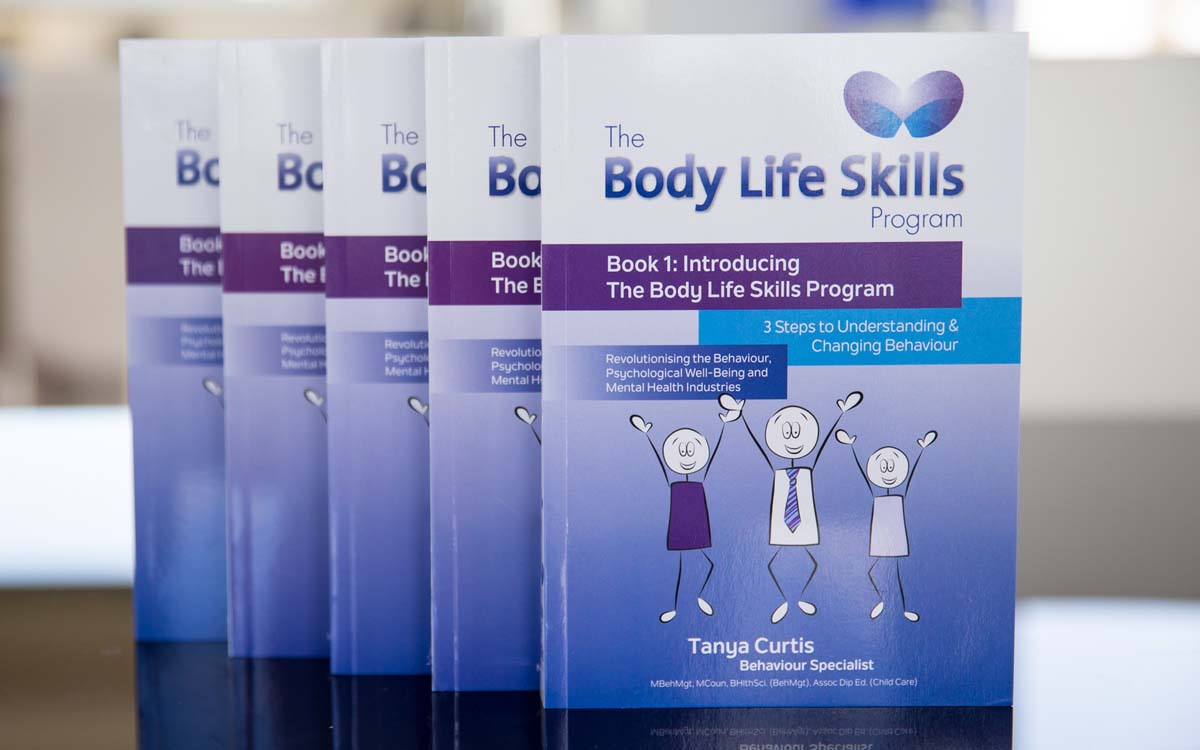
The FABIC Body Life Skills Program provides a practical framework for understanding behaviour without defining the person by what they do.
| Body Life Skills Area | Individualised Question |
|---|---|
| BODY | What is this person’s body doing? What can we observe without labelling or assuming? |
| LIFE | What part of life is being presented, and how might this person be experiencing it? |
| SKILLS | What skill, support or environmental change would help this person feel more equipped? |
Two people may show the same BODY behaviour while facing a different LIFE situation or needing a different SKILL. This is why the framework begins with observation and understanding rather than a pre-selected response.
For example, two people may yell when an appointment begins. One may need a clear visual sequence because they do not know what will happen. Another may understand the appointment but need support to communicate pain. The BODY behaviour is similar, but the LIFE experience and useful SKILLS are different.
Individualised support aims to identify that difference.
Individualised Support Is More Than Choosing a Preferred Activity
Personal preferences matter, but genuine individualisation goes deeper than choosing a favourite colour, food or reward.
It considers:
- whether the person understands what is being asked
- whether the task is accessible at their current skill level
- whether the communication method remains available during stress
- whether health, pain or sensory needs have been explored
- whether the goal improves life for the person or mainly makes things easier for others
- whether strategies work across the settings where the person lives their life
- whether the person and their supporters can realistically use the plan
A plan can appear highly detailed and still fail to be individualised if it is built around assumptions, copied from another person or impossible to implement in daily life.
Support Should Adapt as the Person and Their Life Change
Individualisation is not a one-time assessment followed by an unchanging plan.
People learn. Health changes. Families move. Support workers change. A person may begin school, leave home, start employment, experience bereavement or develop a new way to communicate. A strategy that was useful six months ago may no longer be needed—or may need to be redesigned.
FABIC clinicians describe adaptability as central to their work. The same practitioner may use reflective conversation with one person, games and visual activities with another, then change the approach again when a new behaviour or environmental change emerges. Capacity is not determined by age alone, and a person’s presentation in one session does not define what they can do in every setting.
Ongoing review should ask:
- Is the support still addressing the reason it was introduced?
- Does the person understand and accept the strategy?
- Are we seeing improvement in quality of life, communication, participation or safety?
- Has the person developed new skills that allow support to be reduced?
- Have new health, environmental or relationship factors appeared?
- What is the person, family and support team telling us?
Changing a strategy is not necessarily evidence that the original plan failed. It can be evidence that the team is listening and responding to new information.
Why Generic Strategies Sometimes Fail
Generic advice can be a useful starting point, but it becomes risky when it is treated as a universal answer.
A strategy may fail because:
- it addresses the appearance of behaviour rather than its function
- the person cannot understand or access the communication being used
- the environment continues to create pain, overload or confusion
- the skill being taught is too advanced or not relevant to the person’s goal
- the plan depends on resources the family or team does not have
- different supporters use the strategy in contradictory ways
- the person’s health or circumstances have changed
- the strategy prioritises compliance rather than capability and quality of life
When support is not working, the answer is not automatically to apply the same strategy more firmly. It may be time to pause, gather better information and reconsider the hypothesis.
What Should an Individualised Support Plan Include?
The content will depend on the service and purpose of the plan, but a useful individualised plan should make the person more understandable—not reduce them to a list of behaviours.
It may include:
- the person’s own goals, priorities and preferred future
- strengths, interests and existing capabilities
- preferred communication methods and signs of reduced capacity
- important health, sensory, cultural and environmental considerations
- clear descriptions of behaviour without judgemental labels
- possible functions and contributing factors supported by assessment
- preventative environmental and communication supports
- skills to teach and how they will be taught
- safe responses when distress or risk increases
- the responsibilities of family members, workers and clinicians
- how progress will be measured in ways meaningful to the person
- when the plan will be reviewed and adjusted
For NDIS behaviour support, plans should be tailored and evidence-informed, responsive to the participant’s needs and focused on quality of life, functional skills, meaningful participation and reducing restrictive practices.
Questions Families and Support Coordinators Can Ask
When choosing or reviewing support, consider asking:
- How will you get to know the person beyond their diagnosis?
- How will the person be involved in decisions and goal-setting?
- How will you adapt communication to their preferred method and capacity?
- How will you consider health, sensory, environmental and relationship factors?
- How do you determine what sits beneath a behaviour?
- How will strategies be tested in everyday life?
- How will family members, carers and workers be supported to implement the plan consistently?
- How will progress be measured, and when will the plan be changed?
- How will the support build skills rather than create unnecessary dependence?
A good provider should be able to explain not only what they recommend, but why it is relevant to this person.
How Can Families and Support Teams Help Individualise Support?
Families, carers and support workers often hold valuable knowledge about the person across time and environments. Useful information may include:
- what a settled and enjoyable day looks like
- early signs of pain, anxiety, fatigue or overload
- how the person shows agreement, refusal or uncertainty
- activities, people and environments that support engagement
- recent changes in sleep, health, medication, relationships or routine
- what has been tried, where it was tried and what happened
- skills the person uses in one setting but not yet in another
Recording observable details is often more useful than labels. “He was challenging all afternoon” gives little information. “He covered his ears, pushed lunch away and left the room after the maintenance work began” offers several practical areas to explore.
The person’s own account remains essential wherever possible. When someone communicates without speech, practitioners should work with them and trusted communication partners to understand how their preferences, discomfort and choices are expressed.
Individualisation, Safety and Boundaries
Individualised support does not mean removing every expectation, accepting harm or allowing unsafe behaviour to continue.
Clear boundaries and safety planning may still be necessary. The difference is that limits are paired with understanding, accessible communication, proactive support and skill-building. We can respect the person while being clear that a particular behaviour is unsafe.
For example:
“I can see this is difficult. I will give you space, and I will not let anyone be hit. When we are both settled, we can work out another way to show that you need the activity to stop.”
The aim is not to choose between empathy and safety. It is to provide both.
For more on this balance, see FABIC’s guidance on setting boundaries that support safety and development.
Frequently Asked Questions
Does the same diagnosis mean the same support needs?
No. A diagnosis can identify a recognised pattern and guide further assessment, but people with the same diagnosis can have different communication, sensory experiences, health conditions, strengths, goals, environments and levels of support need. Support should be based on the individual, not the label alone.
What is the difference between person-centred and individualised support?
The terms overlap. Individualised support is tailored to the person’s particular needs, strengths and circumstances. Person-centred practice also emphasises the person’s rights, voice, choices, goals and involvement in planning and delivery. Support can be tailored on paper but still fail to be person-centred if the person has little influence over it.
Can a diagnosis still be helpful?
Yes. A diagnosis may support understanding, identity, access to services and appropriate clinical exploration. The concern is not diagnosis itself, but treating it as a complete explanation of the person or automatically prescribing the same response for everyone who shares it.
Why might a strategy work for one person but not another?
The people may be using similar behaviour for different reasons, have different skills, understand communication differently or experience the environment in different ways. A strategy may also stop working when health, relationships, routines or capacity change.
How often should an individualised plan be reviewed?
Review timing depends on the type of support and relevant requirements, but a plan should be reconsidered whenever it is not producing the intended outcome, risk changes, new behaviour emerges, circumstances change or the person develops new skills. Review should be meaningful rather than a paperwork exercise.
What if a person cannot explain what support they need?
Not being able to explain a need through speech does not mean the person has no preferences or cannot participate. Support may involve AAC, visuals, observation, supported decision-making, extra processing time and input from trusted people who understand the person’s communication. Assumptions should remain open to review.
What is individualised behaviour support under the NDIS?
Individualised behaviour support uses assessment to understand the participant, the function of behaviour and the circumstances that influence it. Strategies are tailored to the participant’s needs, rights, goals and environment, with a focus on quality of life, skill development and reducing and eliminating restrictive practices.
How FABIC Can Help
FABIC provides multidisciplinary support across behaviour support, psychology, counselling, occupational therapy, speech pathology and practical skill-building. Our approach is based on understanding the person and what sits beneath behaviour, then identifying the skills and support that may help create lasting change.
Support may include:
- functional behaviour assessment
- positive behaviour support and behaviour support planning
- psychology and counselling
- occupational therapy
- speech pathology and communication support
- training, coaching and collaboration with families and support teams
Rather than assuming that a diagnosis tells us everything, FABIC practitioners work to understand how life is being experienced by the individual and what may help them feel more equipped.
Learn more about FABIC’s Behaviour Support services:
https://www.fabic.com.au/clinical-services/behaviour-support-practitioner/
References and Further Reading
- FABIC: Behavioural and Developmental Assessments
- FABIC: The Body Life Skills Program
- NDIS Quality and Safeguards Commission: Person-Centred Practice Evidence Summary
- NDIS Quality and Safeguards Commission: NDIS Practice Standards
- Autism CRC: Research and Publications on Diversity Across the Autism Spectrum
This article provides general information and is not a substitute for individual clinical, medical or emergency advice. If behaviour has changed suddenly, pain or illness may be involved, or there is an immediate risk of harm, seek appropriate professional or emergency assistance.
If you are looking for support that sees the whole person—not only their diagnosis—FABIC’s multidisciplinary team is here to help. We can work with individuals, families and support teams to understand behaviour, identify meaningful goals and develop practical strategies tailored to everyday life.