When behaviour is affecting safety, relationships, learning, independence or everyday life, it is understandable to want an answer—and often a quick solution.
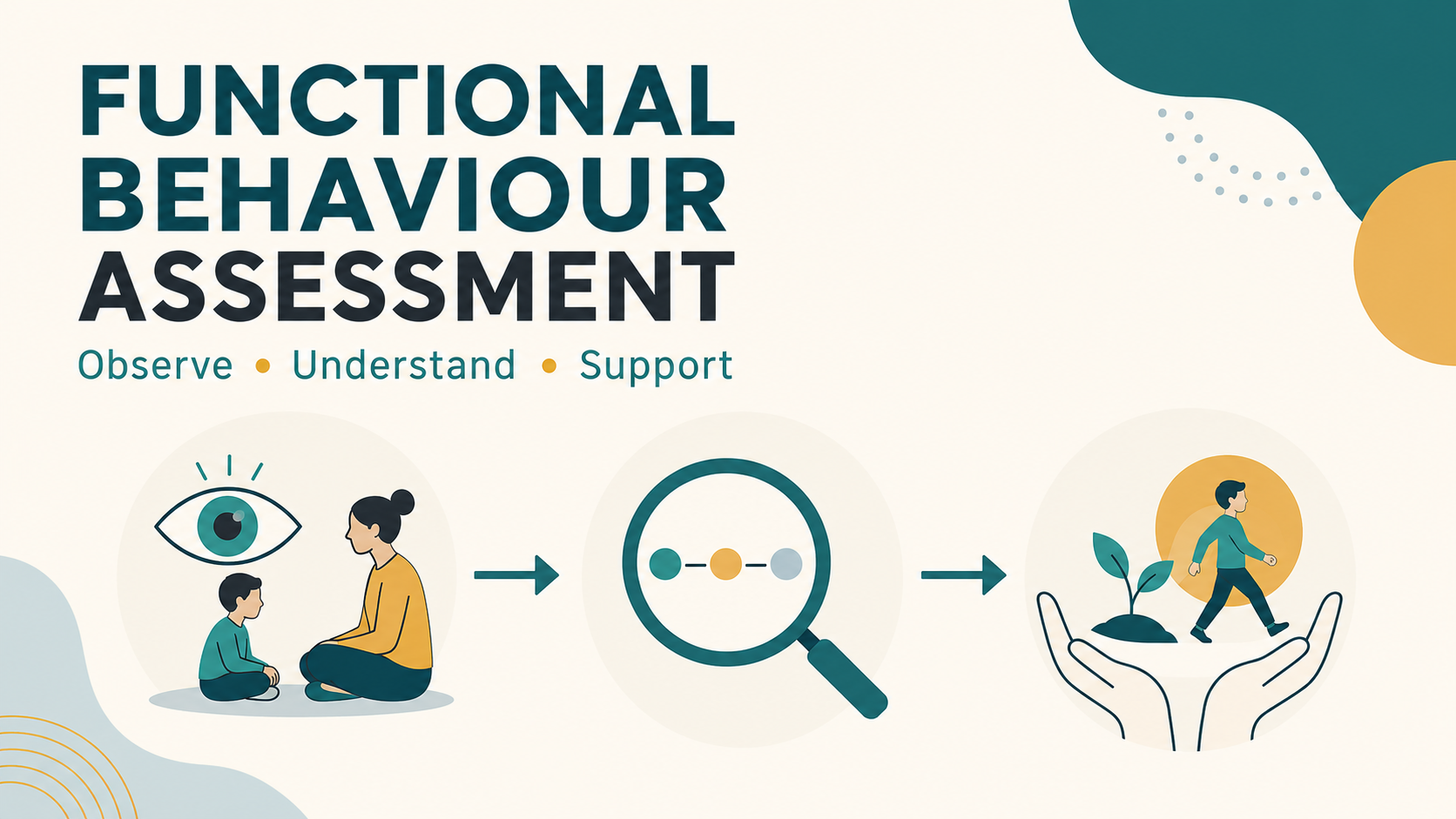
But before we can decide what support may help, we need to understand what the behaviour is communicating or achieving for that particular person. That is the purpose of a Functional Behaviour Assessment, often shortened to FBA.
A Functional Behaviour Assessment is a structured, collaborative process used to understand why a behaviour occurs. It brings together information about the person, the behaviour, what happens before and afterwards, and the wider circumstances in which it is more or less likely to happen. The practitioner then develops and tests a working explanation—called a hypothesis—about the behaviour’s function or purpose.
An FBA is not about deciding that someone is “difficult”, proving who is at fault or finding a single person to blame. It is about replacing assumptions with careful observation and using what is learned to create safer environments, teach useful skills and develop support that makes sense in real life.
This article explains what a Functional Behaviour Assessment is, what actually happens during one, what families and support teams may be asked to contribute, and how the findings can guide an individualised behaviour support plan.
What Is a Functional Behaviour Assessment?
A Functional Behaviour Assessment is a process for determining and understanding the function or purpose behind a person’s behaviour.
In this context, “function” does not mean that the behaviour is planned, calculated or deliberately used to cause difficulty. It refers to what the behaviour helps the person access, communicate, change, avoid or regulate—even when the person is not consciously aware of that process.
For example, a person may leave a room because:
- the sound or number of people has become overwhelming
- they do not understand the activity and cannot ask for help
- they are experiencing pain, illness, fatigue or another physical concern
- the activity has become too difficult or unpredictable
- they want access to a quieter place, preferred activity or trusted person
- leaving has previously been the most reliable way to end an unwanted situation
The visible behaviour is the same: leaving the room. The reason may be very different. If we respond without understanding that difference, even a well-intended strategy can miss the person’s actual need.
The Australian NDIS Quality and Safeguards Commission describes FBA as a process that may use data, observations and other information to understand the events and circumstances that trigger and maintain behaviour. That functional understanding should then be considered within the broader context of the person’s life.
Why Is It Called “Functional”?
The word “functional” can sound clinical, but the idea is practical: behaviour usually does something for the person.
It may help them:
- access something or someone
- avoid or move away from something
- communicate a need, preference or refusal
- gain help, connection, predictability or reassurance
- respond to sensory input or internal physical sensations
- cope when the demands of life feel greater than the skills available in that moment
A functional explanation is more useful than a label. Saying “He is attention-seeking” tells us very little and can invite judgement. Asking whether he is seeking connection, reassurance, assistance, shared enjoyment or confirmation that someone is available gives us something meaningful to investigate.
Equally, what looks like a social function may have a medical or physical explanation. FABIC clinicians emphasise the importance of keeping several possibilities open. A change in behaviour could relate to illness, pain, sleep, medication, sensory discomfort, grief, communication difficulty or a change in the person’s environment. Good assessment does not decide the answer first and collect evidence afterwards.
What Is the Difference Between a Trigger and a Function?
Triggers and functions are related, but they are not the same thing.
| Term | What It Means | Example |
|---|---|---|
| Trigger or antecedent | Something that happens before the behaviour and may increase the likelihood of it occurring. | A preferred activity ends and a new task is introduced. |
| Behaviour | What the person observably says or does. | The person pushes the materials away, yells and leaves the table. |
| Consequence or outcome | What happens immediately after the behaviour. | The task is removed and the person returns to the preferred activity. |
| Possible function | The outcome the behaviour may help the person access or avoid. | Avoiding a task that feels confusing, difficult or too sudden. |
The end of the preferred activity may be the immediate trigger. It does not, by itself, tell us why leaving occurs or what support is needed.
The practitioner may need to ask further questions. Did the person understand the task? Was the transition communicated clearly? Could they request more time or help? Was the environment uncomfortable? Had they slept poorly? Does leaving always result in the task disappearing? The fuller pattern matters.
When Might a Functional Behaviour Assessment Be Recommended?
An FBA may be considered when behaviour:
- creates a risk of harm to the person or others
- regularly limits participation at home, school, work or in the community
- affects relationships, learning, communication or independence
- has changed suddenly or become more frequent or intense
- is being responded to inconsistently across a support team
- continues despite several strategies being tried
- may lead to, or is already associated with, the use of restrictive practices
- needs to be better understood before a comprehensive behaviour support plan is developed
An assessment does not have to wait until a situation reaches crisis point. Earlier assessment can help identify patterns, unmet needs and skills to build before risks become more serious.
A sudden or unexplained change in behaviour can also require medical attention. An FBA should not be used to explain away possible pain, illness, medication effects, seizures, mental health concerns or other changes in health. Relevant health professionals may need to be involved alongside behaviour support.
What Actually Happens During a Functional Behaviour Assessment?
No two assessments are exactly alike. The process should be adapted to the person, their communication, circumstances, risks and goals. However, most comprehensive assessments involve the following stages.
1. The Referral and Initial Conversation
The process usually begins with a referral and an initial discussion about what has been happening, why support is being requested and who should be involved.
The practitioner may ask:
- Which behaviours are causing concern, and for whom?
- What impact are they having on the person’s quality of life?
- Are there immediate safety concerns?
- What has already been tried?
- What would meaningful improvement look like to the person?
- Who knows the person well across different environments?
- How does the person communicate, make decisions and show agreement or refusal?
The practitioner should explain the purpose and likely process in a way the person can understand. Consent, privacy, the person’s rights and how information will be used should be discussed. Under the NDIS, assessment should be person-centred and involve the participant and their support network.
2. Learning About the Whole Person
An FBA is focused on behaviour, but it should never look at behaviour in isolation.
The practitioner may gather information about:
- the person’s strengths, interests, preferences and goals
- communication methods, including speech, AAC, signs, gestures and body language
- daily routines and important relationships
- health, pain, sleep, eating, medication and sensory experiences
- diagnoses and previous assessments
- learning history and skills already available
- culture, identity, trauma, grief and significant life changes where relevant
- environments in which the person feels more or less settled
- what a good day looks like from the person’s perspective
This prevents the behaviour from becoming the only thing people see. It also helps identify quality-of-life changes that may be more important than simply reducing an incident count.
3. Defining the Behaviour Clearly
Words such as “aggressive”, “defiant”, “meltdown”, “uncooperative” or “shutting down” can mean different things to different people. For an assessment to be useful, the behaviour must be described in observable terms.
Instead of writing “becomes aggressive”, an operational description might say:
“The person hits another person with an open or closed hand, pushes them with both hands, or kicks towards their body.”
The wording should make it possible for different observers to recognise the same behaviour. The practitioner may also consider:
- how often it occurs
- how long it lasts
- its intensity and associated risks
- where and when it is more or less likely
- early signs that may appear before escalation
- when the behaviour does not occur, even though a similar situation is present
Clear description separates the person from what they do. It also makes progress easier to measure.
4. Speaking With the Person and Their Support Network
Interviews, conversations and questionnaires are sometimes called indirect assessment. They help the practitioner understand the behaviour through the experiences of the person and others who know them well.
This may include the person, family members, guardians, support workers, teachers, therapists, house supervisors or other relevant people. Different people may notice different patterns because they see the person in different places and at different times.
Disagreement is not necessarily a problem. One worker may report that a behaviour “comes from nowhere”, while another notices that it usually follows a crowded transition. Rather than choosing who is right, the practitioner can investigate why experiences differ.
The person’s own voice remains essential. If speech is not their preferred or most reliable communication method, the practitioner should use accessible alternatives and seek help from familiar communication partners where appropriate. Non-speaking does not mean the person has nothing to contribute.
5. Reviewing Existing Information
With appropriate consent, the practitioner may review existing documents such as:
- previous behaviour support plans and assessments
- incident reports and progress notes
- health, medication and allied health information
- communication profiles and sensory assessments
- school or workplace information
- records showing when, where and how often behaviour occurs
More paperwork does not automatically create a better assessment. The aim is to identify useful patterns while checking the quality and context of the information. Notes such as “had a bad day” are less helpful than a clear account of what happened before, during and after the event.
6. Observing the Person in Relevant Environments
Direct observation helps the practitioner compare what has been reported with what happens in everyday life. Depending on the situation, observation may occur at home, school, work, supported accommodation, a community setting or during a session.
The practitioner may observe:
- the demands and transitions occurring around the person
- how information and choices are presented
- noise, space, waiting, unpredictability and other environmental factors
- early signs of anxiety or reduced capacity
- how other people respond
- what changes immediately after the behaviour
- situations in which the person participates successfully
The practitioner does not necessarily need to witness the most serious behaviour directly. It may be unsafe, unethical or unnecessary to provoke a high-risk event. Useful information can be gathered from safer observations, records, interviews and patterns across time.
7. Collecting and Analysing Data
Data collection helps move the process beyond memory and impression. The practitioner may ask supporters to record specific information in a simple and consistent way.
An ABC record is one commonly used tool:
| A: Antecedent | B: Behaviour | C: Consequence |
|---|---|---|
| What happened immediately before? | What did the person observably say or do? | What happened immediately afterwards? |
Other records may track frequency, duration, intensity, time of day, location, people present, health or sleep factors, activities and successful periods.
Data should support curiosity, not surveillance. It should collect only what is relevant, protect the person’s privacy and be interpreted within context. A spreadsheet can reveal a pattern, but it cannot replace listening to the person.
8. Developing a Functional Hypothesis
The practitioner brings the information together into a functional hypothesis: a clear, testable explanation of when the behaviour is likely to occur, what may be influencing it and what outcome may be maintaining it.
A hypothesis might look like this:
“When an unfamiliar or multi-step task is presented without visual support, particularly when the person is tired, they are more likely to push materials away, yell and leave. This behaviour is likely to help them end or delay a task they do not yet understand and cannot reliably request help with.”
This is not a permanent verdict. It is the best explanation supported by the available evidence. It should be checked against new observations and changed if it does not adequately explain what is happening.
9. Turning the Findings Into Practical Support
The value of an FBA is not the assessment document itself. The value is what the understanding allows the person and their team to do differently.
Recommendations may include:
- changing parts of the environment that create unnecessary difficulty
- making routines, expectations and transitions more predictable
- adapting communication and allowing more processing time
- teaching a reliable way to request help, a break, more time or a change
- building regulation, daily living, social or coping skills
- responding consistently to early signs and behaviours of concern
- increasing meaningful choice, participation and positive connection
- referring to medical or allied health professionals where further assessment is needed
- reducing and eliminating restrictive practices where they are present
For NDIS participants, the FBA commonly informs a comprehensive behaviour support plan. The plan should explain preventative strategies, skills to teach, safe response strategies, implementation responsibilities and how progress will be monitored.
10. Checking Whether the Understanding Is Correct
Assessment does not finish when a report is sent.
The practitioner and support team should monitor whether the strategies are being implemented, whether the person is developing useful skills, whether quality of life is improving and whether the behaviour changes in the way the hypothesis predicted.
If the plan does not help, the conclusion should not automatically be that the person is “refusing” or that the family has failed. It may mean:
- the original hypothesis was incomplete
- an important health, communication or environmental factor was missed
- the alternative skill is not yet reliable or easy enough to use
- supporters need more coaching or consistency
- the person’s circumstances or priorities have changed
A good FBA is dynamic. Understanding should deepen as the person, practitioner and support team learn more.
Indirect Assessment, Direct Observation and Functional Analysis
These terms are sometimes used as though they mean the same thing, but they describe different ways of gathering information.
| Method | What It May Involve |
|---|---|
| Indirect assessment | Interviews, questionnaires, record reviews and information from the person and people who know them. |
| Direct descriptive assessment | Observing behaviour and surrounding events in ordinary environments without deliberately changing conditions. |
| Functional analysis | Systematically changing carefully controlled conditions to test possible functions. This is a specialised procedure requiring strong safeguards, appropriate expertise and an individual risk assessment. |
A Functional Behaviour Assessment may draw on several methods. A formal functional analysis is not automatically part of every FBA and should not be confused with ordinary observation. The practitioner selects methods that are proportionate, ethical, safe and appropriate for the person and the question being investigated.
How Long Does a Functional Behaviour Assessment Take?
There is no single assessment length that suits every person.
The time required can depend on:
- the complexity and level of risk involved
- how often the behaviour occurs
- the number of behaviours and environments being assessed
- the person’s communication and participation needs
- how quickly records, observations and stakeholder information can be gathered
- whether medical, communication, sensory or other specialist input is required
- whether there are regulated restrictive practices or formal NDIS timeframes involved
It may involve several conversations, observations and periods of data collection rather than one appointment. For NDIS behaviour support plans that include regulated restrictive practices, current rules set specific timeframes for interim and comprehensive plans. The practitioner should explain which requirements apply to the person’s situation.
Taking enough time to understand patterns is important, but assessment should not become an endless information-gathering exercise. Immediate safety and helpful interim supports may need attention while the fuller assessment continues.
What Will Families, Carers and Support Workers Be Asked to Do?
People close to the individual often hold essential knowledge. They may be asked to:
- share what they have noticed without needing to prove a particular explanation
- describe the behaviour in specific, observable language
- identify what tends to happen before and after it
- record agreed information for a period of time
- share what helps, what makes things harder and when the person is most successful
- support the person to communicate their experience and preferences
- participate in reviewing the hypothesis and recommendations
- learn and consistently practise agreed support strategies
You are not expected to arrive with a diagnosis of the behaviour’s function. “I don’t know” is valid information. Honest uncertainty gives the practitioner more room to investigate than a confident assumption that may be inaccurate.
It is also helpful to share what is going well. An assessment that records only incidents can miss the conditions in which the person already feels safe, connected, capable and engaged.
What Should the Person Experience During a Good FBA?
A Functional Behaviour Assessment is being conducted with a person, not done to them.
Good practice should support the person to experience:
- respect and freedom from judgement
- information in a format they can understand
- meaningful involvement in decisions
- recognition of their strengths, goals and preferences
- communication access and sufficient processing time
- privacy and appropriate consent
- safe methods that do not create unnecessary distress
- support directed towards quality of life, participation and skill development
The person may not agree with every concern raised by others. Their perspective should still be sought and taken seriously. Sometimes the person’s goal is not “stop the behaviour” but “help people understand me”, “make the noise stop”, “give me a way to say no” or “let me know what is happening”. Those goals can change the direction and quality of support.
What an FBA Is Not
A Functional Behaviour Assessment is not:
- a test that someone passes or fails
- a diagnosis, although diagnostic and health information may form part of the broader picture
- a judgement of parenting or support work
- a single checklist or questionnaire
- proof that every behaviour has one simple cause
- a licence to ignore distress because a function has been named
- a plan for making someone compliant
- a finished answer that never needs review
Behaviour can have more than one function. The same behaviour may serve different functions in different situations, and several behaviours may serve a similar function. Any explanation must remain connected to evidence and open to revision.
How FABIC’s Body Life Skills Program Relates to FBA
Functional assessment is central to FABIC—its name originally comes from Functional Assessment and Behaviour Interventions Clinic.
The FABIC Body Life Skills Program provides a practical, accessible way of applying the principles of Functional Behaviour Assessment. It considers three connected areas:
| Body Life Skills Area | Assessment Question |
|---|---|
| BODY | What is the person’s body observably doing? This describes the behaviour without making it their identity. |
| LIFE | What part of life is being presented that the person may not yet feel equipped to respond to? |
| SKILLS | What skills, environmental changes or supports could help the person respond to that part of life? |
This keeps assessment focused on understanding and skill-building. The person is not the behaviour. The behaviour is something their body is doing in response to life, using the capacity and skills available at that time.
For example, if the BODY behaviour is tearing up a worksheet, the LIFE situation may involve an unfamiliar literacy task presented in front of peers. Useful SKILLS and supports could include asking for help, recognising rising anxiety, using an appropriate break request, presenting work at an accessible level and receiving instructions in smaller steps.
The goal is not merely an intact worksheet. It is a person who feels increasingly equipped to communicate, participate and respond to that part of life.
Learn more about Functional Behavioural Assessments and the Body Life Skills Program.
How Does an FBA Inform a Behaviour Support Plan?
The FBA explains the current understanding of why behaviour happens. A behaviour support plan translates that understanding into what people will do.
A strong plan may include:
- the person’s strengths, goals, communication and preferences
- a clear description of behaviours and risks
- the functional hypothesis
- environmental and preventative supports
- skills to teach and how they will be taught
- early signs and agreed responses
- strategies for maintaining dignity and safety during incidents
- roles, training and consistency across the support team
- ways to monitor outcomes and quality of life
- strategies to reduce and eliminate restrictive practices, where relevant
If the hypothesis is that yelling and leaving help a person escape instructions they cannot process, the plan should not simply say, “Do not allow escape.” It might instead improve how instructions are presented, teach a practical help or break request, adjust task difficulty and support gradual participation.
The replacement behaviour must work for the person. Asking appropriately for help will not replace yelling if nobody reliably notices or responds to the request.
You can read more about FABIC’s Behaviour Support Practitioner services.
Common Questions About Functional Behaviour Assessments
Does an FBA require the practitioner to see the behaviour happen?
Not always. Direct observation can be valuable, but it may be unsafe or impractical to wait for or deliberately trigger serious behaviour. A practitioner can combine safer observations with interviews, incident information, records and data collected across relevant settings. The strength of the assessment comes from integrating multiple sources and checking whether the explanation fits the available evidence.
Is an FBA only for autistic people or NDIS participants?
No. Functional assessment principles can be used with people of different ages, diagnoses and circumstances. However, there are specific legal, professional and documentation requirements when an FBA is conducted as part of NDIS specialist behaviour support.
Is an FBA the same as an autism or ADHD assessment?
No. An autism or ADHD assessment investigates whether a person meets diagnostic criteria. An FBA investigates why a particular behaviour occurs and what support may help. A person may have both types of assessment, but they answer different questions.
Can one behaviour have several functions?
Yes. A behaviour may help a person achieve different outcomes in different situations. It may also be influenced by several factors at once. For example, a person may leave because a task is difficult, the room is noisy and leaving reliably leads to a familiar supporter providing help.
What if different people disagree about why the behaviour happens?
This is common and can provide useful information. The practitioner can clarify what each person has observed, compare settings, collect more specific data and test which explanation best fits the pattern. An FBA is intended to reduce reliance on opinion, not silence different perspectives.
Will the assessment blame our family or support team?
It should not. Other people’s responses and environmental conditions are relevant because behaviour happens within a context, but the aim is understanding—not blame. Everyone involved may discover small changes that make support more effective. Families and workers should also receive practical guidance rather than being handed recommendations without help implementing them.
Does understanding the function mean accepting harmful behaviour?
No. Safety and boundaries still matter. Understanding the function helps the team respond more effectively, reduce unnecessary confrontation and teach safer alternatives. It explains behaviour without defining the person by it or suggesting that harm is acceptable.
What happens after the FBA report is completed?
The findings should guide an individualised intervention or behaviour support plan. The practitioner should explain the conclusions, support implementation, monitor outcomes and revisit the assessment when new information emerges or the person’s circumstances change. A report that sits unread in a folder is not the intended outcome.
How to Prepare for a Functional Behaviour Assessment
You do not need to prepare a perfect case file. A few practical steps can make the first conversation easier:
- write down the main behaviours you want help understanding
- note where, when and with whom they are more or less likely
- bring relevant plans, reports, communication information and medication details
- identify recent changes in health, sleep, routine, relationships or environment
- consider what the person wants and what a better everyday life would look like
- list the people who know the person well across different settings
- bring questions about consent, privacy, timeframes, costs and expected outcomes
Most importantly, bring curiosity. You are not expected to already know the answer. Finding a more reliable answer is the purpose of the assessment.
Choosing a Functional Behaviour Assessment Provider
Useful questions to ask include:
- Who will conduct the assessment, and are they appropriately qualified or considered suitable for the NDIS work required?
- How will the person be involved and supported to communicate?
- Which environments and members of the support network may be included?
- How will health, communication, sensory and environmental factors be considered?
- What information will be collected, and how will privacy be protected?
- How will findings be explained in an accessible way?
- Will implementation, team training and review be available after the report?
- How will progress be measured beyond simply counting incidents?
A high-quality assessment should leave the person and their supporters with greater understanding and a clearer way forward—not simply a new label for the behaviour.
Functional Behaviour Assessment at FABIC
FABIC offers Functional Behaviour Assessments to investigate the reasons behind specific behaviours and lay the foundation for an individualised intervention plan.
Our approach is grounded in a simple but important principle: always meet the person for who they are, not what they do. We look beyond the visible behaviour to understand the LIFE situation being presented and identify the SKILLS and supports that can help the person feel more equipped.
This may involve collaboration with the person, family members, carers, support workers, educators and other professionals. The aim is to develop practical recommendations that can be understood and used consistently in everyday environments.
Learn more about FABIC’s assessment and behaviour support services:
- Functional Behaviour Assessments and other FABIC assessments
- Behaviour Support Practitioner services
- The Body Life Skills Program
References and Further Reading
- NDIS Quality and Safeguards Commission: Behaviour Support Assessment, Including Functional Behaviour Assessment—Practice Guide
- NDIS Quality and Safeguards Commission: Rules for Specialist Behaviour Support Providers and NDIS Behaviour Support Practitioners
- NDIS Quality and Safeguards Commission: How to Develop Behaviour Support Plans
- FABIC: Functional Behavioural Assessments and the Body Life Skills Program
- FABIC: The Body Life Skills Program—An Evidence-Based Approach to Lasting Behaviour Change
General information only: This article is educational and does not replace an individual medical, psychological, communication or behaviour support assessment. Follow any current professional or safety plan developed for the person. If there is an immediate risk of serious harm, call Triple Zero (000) or contact the appropriate emergency or crisis service.
A Better Question Creates a Better Starting Point
When behaviour is difficult, the first question is often, “How do we stop this?”
A Functional Behaviour Assessment begins one step earlier: “What is happening here, and why might this behaviour make sense for this person in this situation?”
That question does not remove boundaries or minimise risk. It gives us a better foundation for action. When we understand what the person is responding to and what the behaviour achieves, we can make informed changes, teach meaningful skills and build support that is more respectful, consistent and likely to last.
If behaviour is affecting daily life, participation, relationships or safety, FABIC can help you understand what may be sitting beneath it and identify practical next steps.